How to Source Top Tech Talent More Effectively
A Guide To Skills-Based Hiring

Introduction
Finding the perfect fit for a tech role can feel like searching for a unicorn. To add to this challenge, strict requirements from hiring managers can add another layer of complication to already stressful candidate searches. But what if there was a way to expand your talent database and find those hidden gems more easily?
A conflicting set of dynamics challenges today’s hiring market. On the one hand, the tech layoffs that started in 2022 have continued, making tech professionals with high-demand skills nervous. On the other hand, heightened exuberance for emerging technologies like generative AI are putting an even higher premium on technology talent and creating a technology talent gap. The stakes are high: companies struggling to recruit that talent are already putting off strategic projects, leading to a potential $8.5 trillion in unrealized revenues by 2030.
For recruiters, the talent gap shows up as not enough technology candidates to fill the available roles, as well as candidates that seem to have the right tech credentials (e.g. degree and work history) without the right skills for the current moment. That combination of a tight talent market and rapid changes in high-demand skills are driving more HR leaders to embrace skill-based talent management.
What is Skills-Based Hiring?
Skill-based talent management, or skills-based hiring, is a business approach that emphasizes a person’s abilities as a basis for hiring or promotion. It stands in contrast with the more traditional role-based focus by putting less weight on a candidate’s formal education or prior roles as evidence of their ability to be successful in a position.
Skills-based hiring is not a new concept. It dates at least as far back as 1992, when University of Southern California business school professors Edward Lawler and Gerald Ledford published a paper positing that skills-based human resource management has advantages over more typical role-based hiring. Despite its history, skills-based hiring has only recently been embraced by a significant share of mainstream employers. Challenges such as pay equity, conflicting HR priorities and operational challenges associated with such a dramatic mindset shift are likely to blame for such a slow adoption process.
One of the most common approaches to skills-based hiring in recruitment is to do away with college degree requirements for roles that do not in reality involve four-year college-level skills. Technology companies like IBM, Dell, and Google have gone on the record saying they are reducing college degree requirements for some tech roles. So too are large non-tech firms like Bank of America.
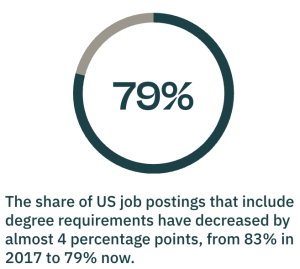
They are not the only ones. Skills-based hiring has become popular for both private sector companies and government agencies looking to address their talent shortages. Since 2017, the share of US job postings that include degree requirements have decreased by almost 4 percentage points, from 83% to 79%.
Beyond dropping or de-emphasizing degrees, talent managers may also look outside of the IT department for technology talent. Many organizations have grown their pool of business tech professionals, citizen data scientists, and other non-technology department roles in order to keep up with the business units’ demand for technology. That perfect candidate may have spent their career up to now in finance, not IT, yet has the data analytics skills your organization needs for its AI center of excellence.

That perfect candidate may have spent their career up to now in finance, not IT, yet has the data analytics skills your organization needs for its AI center of excellence.
Why Skills-Based Hiring May Become Mission-Critical in Tech
Businesses in the technology sector, and the tech teams outside of it, are positioned to gain the most from a skills-based hiring approach. This is partly because technology is in a constant state of flux, with new skills emerging and existing ones becoming outdated at an ever-increasing pace. This landscape creates a unique workforce and as a result, tech professionals are naturally adept at continuous learning and positioning themselves based on the latest in-demand skillsets.
Skills-based hiring aligns perfectly with the way both recruiters and candidates navigate the tech talent market: recruiters can target individuals with the right skillsets, regardless of traditional markers like degrees, and candidates can showcase their adaptability and ongoing learning. With skills obsolescence a constant concern, focusing on skills over pedigree makes hiring easier and more effective.
What are the Benefits of Skills-Based Hiring in Tech?
An Alternative to Role-Based ApproachesRole-based hiring is the status quo on most teams and implies that the hiring team predicates much of the hiring process on former job titles and education. Title inflation, degree inflation, unconscious bias, and inefficiency are all ways that the current role-based hiring system fails us. However, as discussed in the previous section, skills-based hiring offers a better way to source candidates, getting around many of these challenges and bringing with it several undeniable benefits.

Growing Your Tech Candidate Database
Removing the filters that limit a candidate pool without increasing candidate quality can radically increase the number of eligible candidates. Suddenly, you can take a look at a software engineer with two years of experience doing a similar job you are trying to fill, but who would have been disqualified in the past because they only have an associate’s degree or a handful of bootcamp certifications.
The skills-based lens can be especially useful to add internal candidates to your hiring pool. A marketing technologist or an HR data analyst may have the right skills profile for an open IT role. In the past, you would not have noticed them because their title did not signal the right fit. A skills-based approach uncovers those opportunities. This includes opportunities to recruit AI talent, as we highlight in our new Technical Recruiter’s Guide to Building an AI Team.

Accessing More Diverse Tech Talent
Women and BIPOC continue to be underrepresented in technology compared with white men. Recruiters may unintentionally add to that imbalance when they enforce degree requirements, since both women and BIPOC professionals are less likely than white men to have a bachelor’s degree in the science, technology, engineering, and math fields. Bias against people with less tech experience or those who have made career pivots can also come into play if job postings require candidates to have had certain job titles in the past. A skills-based approach can mitigate those sources of bias by emphasizing what the candidate can do, not how or where they gained those skills. The benefits of diversity translate not only into a larger candidate pool but also into more productive teams.

Elevating the Importance of Soft Skills
The traditional trend of evolving skills in tech often focuses on hard skills like coding in Python or cloud technologies like Kubernetes. Yet hiring managers are also looking for soft skills such as social skills, active learning, and originality. Pearson research on the future of skills finds that these soft skills will be in higher demand by 2030 than hard skills. Soft skills are also less vulnerable to skills obsolescence than hard skills, which may be supplanted by a competing approach, such as a specific programming language or management methodology.

Increasing Employee Loyalty
Filling the open roles in their organizations will always be an extremely high priority for HR leaders. It is equally important to most HR leaders, however, that those candidates stay in their roles. If employee turnover begins happening too frequently, the HR and talent acquisition teams know they will be in a vicious cycle, constantly filling and refilling the same open positions.
Interestingly, skills-based hires are also more loyal hires. They stay slightly longer with the same company and they get promoted at a slightly faster rate than traditional hires. While there are likely other factors that play into it, any adjustments that lead to higher retention should be of great interest to human resources professionals, especially in the current environment.

Aligning Employee Needs with Those of the Business
For so many tech professionals, a good job is not just one that offers competitive pay and attractive benefits. A good job also presents opportunities for tech professionals to grow, learn and upskill themselves. In fact, learning is one of twelve indicators Gallup uses to measure engagement in its annual engagement survey. Pearson also finds that employees want learning and development opportunities. Their motivations reflect the other side of the trend in changing — they know their jobs are evolving and want to develop themselves ahead of the changes in order to stay relevant. With a skills-based focus, organizations create opportunities to leverage upskilled employees in new roles. That benefits everyone.
Barriers to Implementing Skills-Based Hiring
The Challenges Organizations FaceIf skills-based talent management is so great, why isn’t everyone doing it? While the trends toward skills-based hiring are strong, and the benefits promising, executing on a skills-based talent management strategy can be challenging. Often, organizations are stymied by the following issues:
Mindsets
Many HR organizations have spent years developing ideal candidate personas that include education and past role credentials. As a result, many veteran recruiters perceive candidates with a four-year degree to be less risky in their experience than candidates with non-traditional backgrounds. It will take dedicated change management, evidence, and patience to change those mindsets.
Assessment Methods
Organizations used education and experience credentials because they were good proxies for knowledge and capabilities. In their absence, HR professionals will need some other way to assess candidates to confirm they either have the skills you need, or they have the ability to develop them. That transition may require new training for recruiters in different interviewing techniques, as well as investments in assessment tools and approaches.
Traditional onboarding and development
Onboarding a candidate who has done a job similar to the one you are hiring for looks very different from onboarding a candidate whose work experience has been limited or defined by a different work environment from yours. Organizations that fail to take those differences into account will struggle, either because their new hires take longer to reach full productivity, or because they leave sooner due to frustration or a lack of engagement. Successful skills-based talent management requires a full lifecycle approach that considers the person’s needs from recruiting through onboarding and ongoing development. This applies also to onboarding and developing candidates in different generations.
Pay equity
There is no simple answer to the question of pay equity. Two people doing the same job in theory should be paid comparable salaries. Yet there continues to be a gender pay gap in tech. Pay scales also tend to take experience and tenure into consideration, which can lead to significant pay discrepancies. Organizations will need to balance the range of issues that determine fairness in pay in a context where a person’s degree or experience held less weight in hiring than it had in the past.
Measurement
For HR teams that track metrics and are rewarded for meeting their organization’s talent goals, skills-based talent management creates a new paradigm. This shift may require new or different metrics to determine success and incentivize behavior. For example, skills-based HR teams may need to balance recruiting metrics, such as average time to fill a role, with effectiveness metrics, such as employee tenure, to ensure the skills-based strategy does not sacrifice quality for speed.
Conflicting HR priorities
HR teams have been under a lot of pressure in recent years to deliver greater talent outcomes with fewer resources. While narrowing the skills gap is a major driver of HR priorities in 2024, it is not the only driver. Concurrent trends around adopting HR tech and managing the impact of AI on jobs and the workforce may take precedence, and push a systemic change like skills-based talent management to the back of the priority list.
Many veteran recruiters perceive candidates with a four-year degree to be less risky in their experience than candidates with non-traditional backgrounds. It will take dedicated change management, evidence, and patience to change those mindsets.
Adopting a Skills-Based Hiring Approach
Five Tips for Getting StartedIn light of these challenges, consider the following five key ways to begin incorporating skills-based principles into your tech recruitment and internal mobility operations. While they will be most effective as part of a holistic and organization-wide skills-based hiring strategy, recruiters and HR leaders can start to gain some benefits by taking the following steps:

Tackle Your Potential Roadblocks Head on
Many HR organizations have spent years developing ideal candidate personas that include education and past role credentials. As a result, many veteran recruiters perceive candidates with a four-year degree to be less risky in their experience than candidates with non-traditional backgrounds. It will take dedicated change management, evidence, and patience to change those mindsets.

Rethink Current Assessment Methods
Organizations used education and experience credentials because they were good proxies for knowledge and capabilities. In their absence, HR professionals will need some other way to assess candidates to confirm they either have the skills you need, or they have the ability to develop them. That transition may require new training for recruiters in different interviewing techniques, as well as investments in assessment tools and approaches.

Inventory Your Skills Gaps
Urge hiring managers to help you understand their hiring needs, and prompt them to identify the skills that correspond with an open role or title. Work with them as well to help you identify transferable skills to look out for on applications. As we deemphasize the traditional recruitment practice of letting education and job titles serve as proxies for expertise, we need to develop new ways to spot compelling tech candidates and communicate why they are appealing.

Identify Non-Traditional Sources for Skills
Look to non-IT functions or business units that already employ talent with the high-demand skills your organization needs to fill tech roles. Leverage talent analytics platforms to identify “adjacent skills” to the ones you hope to develop — candidates who already have adjacent skills can more easily upskill to the skill you need. Finally, engage with trade schools and community colleges to develop curricula or hold job fairs to spot high-potential recruits.

Adjust Your Resume Review and Interviewing Approach
The challenges of changing mindsets and assessment approaches translate in part to adopting new ways to evaluate resumes and conduct interviews. Without the ability to rely on degrees or traditional career milestones, recruiters will need to conduct skills-based interviews designed to assess some of the skills candidates will need. It is important to also coach hiring managers to do the same.

Explore Creative Ways to Fill Skills Gaps
Filling new roles with permanent candidates, whether internal or external, cannot be the only way that an organization fills its skills gaps. At different times the organization may enact hiring freezes, or the pool of candidates is just too small or too expensive to fit needs. Instead, embrace the skills-based mindset as part of a three-part talent management approach that includes hiring candidates, developing new high-demand skills in existing team members, and “renting skills” through consulting or staff augmentation firms.

Find and Hire Tech Talent with the Right Skills
The future is powered by tech professionals. From automation to machine learning, the talented people behind tech are revolutionizing industries and shaping our world. To keep up, you need the people who can harness this power – the tech talent behind the innovation.
The only problem? It can be hard to know where to find them (let alone how to recruit them). That’s where Dice comes in. We are the tech-specialized hiring platform that drives connections between the teams that need to fill roles and the tech professionals with the skills to be a good fit.
Ready to find the tech talent that will future-proof your business?

About Dice
Dice is a leading tech career hub connecting employers with skilled technology professionals and providing tech professionals with career opportunities, data, insights and advice. Established in 1990, Dice began as one of the first career sites and today provides a comprehensive suite of recruiting solutions, empowering companies and recruiters to make informed hiring decisions. Dice serves multiple markets throughout North America. Dice is a DHI Group, Inc. (NYSE:DHX) brand.
How Dice Can Help
Here’s how Dice helps you find the right tech talent for your open roles.
Keep You up to Date on Hiring Trends
Dice has a finger on the pulse of the rapidly-growing, ever-changing tech hiring market.
Post Your Jobs
Maximize your limited time by leveraging our tech-focused AI and patented tech taxonomy. We’ll match your open roles with the most relevant candidates.
Source Ideal Talent
Gain access to a wide range of tech professionals with complete profiles — and the tools to quickly find which ones best fit your needs.
Elevate Your Brand
Tell your unique company story with solutions that boost your employer brand, showcase your culture and attract the right tech professionals.