





The Dice Tech Salary Report 2025

Tech's Brilliant, Bumpy Evolution

Author

Author Image

Dice Staff

Author

Search

When Dice published its first salary report in 2005, YouTube was just launching, the iPhone didn’t exist, and ‘cloud’ was just a dream to the most forward-thinking innovators. Today, we’re tracking how AI expertise can command an almost 18% salary premium, analyzing why nearly half of employed tech professionals are job hunting, and exploring what is next for tech hiring.

In this data-rich report:

  • We examine how the industry has evolved over two decades, from shifting workplace cultures to transformative technologies. Read More
  • We dig into year over year salary trends across regions, industries, skillsets, experience, and more. Read More
  • We uncover why nearly half of tech professionals are actively searching for a new role, even in an employer’s market. Read More
  • We discuss the traditional benefits decline across every category and remote work policies shift against employee preferences. Read More

Join us for an in-depth look at tech’s brilliant but bumpy evolution—and what it means for building stronger tech teams in 2025 and beyond.

Dive into the Chapters

20 Years in Review

20 Years in Review

From the perspective of tech veterans, explore the transformative moments that shaped our industry—from early internet days to today's AI revolution

Explore our Findings
Tech Salary Trends

Tech Salary Trends

Track salary shifts across regions, roles, and specialties. Discover which skills command the highest premiums and where the biggest growth opportunities lie.

Explore our Findings
Compensation Satisfaction

Compensation Satisfaction

Learn why tech satisfaction hit record lows in 2024, how companies are responding, and what's driving unprecedented job-hunting rates.

Explore our Findings
Benefits and Bonuses

Benefits and Bonuses

Examine how benefit packages are evolving, where employers are investing, and which perks matter most for attracting and retaining tech talent.

Explore our Findings

Survey and Report Methodology

  • Collection of Data

    The 2024 Dice Salary Survey was administered online by Dice.com among registered Dice job seekers and site visitors between August 30, 2024, and November 6, 2024. Respondents were invited to participate in the survey in two ways: 1) via an email invitation to Dice’s registered (searchable) database members and 2) through a notification via website banner on Dice.com user profile page. A total of 2,835 completed surveys are represented in this report (this number excludes unemployed respondents, students, incomplete responses and those who work outside of the U.S.).

  • Data Weighting

    In each year of the survey, the data are reviewed to assess the need for data weighting to ensure that the overall data properly reflect the universe of Dice.com job seekers. Examination of the data from 2024 showed a weighted data adjustment was needed for two variables — gender and age. The impact on the mean salary results from the weighting for the 2024 data increased the average salary by +$7,161.

  • Job Posting Data

    Job posting data was gathered by Dice’s partner, Lightcast (formerly Emsi Burning Glass), which has a database of more than 1 billion current and historical job postings worldwide. Data was used from Lightcast to complete city, occupation and skill callouts.

Overview

Twenty years ago, Google Maps and YouTube were about to launch, the iPhone didn’t exist, and “cloud” mostly referred to a fluffy white body of moisture in the sky. Whether you were just starting your career at the time, or still bringing home permission slips in your Jansport backpack, twenty years is a long time for all of us. As Dice celebrates 20 years of salary reporting, we’ve assembled a unique dataset: detailed survey responses from tech professionals who’ve witnessed and shaped their industry over the past two decades. These tech veterans have navigated multiple economic cycles, technological revolutions, and shifts in workplace culture, creating a living playbook of career decisions that today’s HR leaders and recruiters can use to guide talent acquisition and development.

Prefer to learn in audio?

Click the video to listen to the narrated version of this chapter.

Key Findings

Women in tech with over two decades of experience are nearly 1.5x more likely than men to say the culture in tech has improved over the past 20 years.

Read More

AI and machine learning is the most interesting change in tech in the past two decades, say tech professionals with 20+ years of experience.

Read More

Seasoned tech professionals rank cloud, internet, and mobile as the forces that revolutionized the industry the most in the past 20 years.

Read More

Tech professionals with over 20 years of experience have changed jobs 5.3 times on average over the course of their career.

Read More

How Tech Salaries Weathered Two Decades of Change

A closer look at tech salaries over the last two decades reveals a complex picture. While overall tech salaries have risen steadily since 2005, reaching an average of $112,521 in 2024, the reality is more nuanced when accounting for inflation. Today’s average tech salary, when adjusted for purchasing power, is almost exactly what professionals earned in 2005 ($112,521 versus inflation-adjusted $112,350) – suggesting that despite periodic surges, compensation in tech overall has effectively plateaued over nearly two decades.

However, this flattening of purchasing power needs to be viewed in the context of broader economic trends. For one thing, the median U.S. household income has fared worse, rising from $58,000 in 2005 to $80,610 in 2023 – a gain that significantly trails inflation. While tech professionals haven’t seen real gains in purchasing power, they have at least maintained their position while many other sectors have experienced decline.

This pattern of stability has continued through recent market corrections, as well. Despite tech companies facing revenue pressures and implementing widespread layoffs throughout 2023 and 2024, particularly among giants that had over-hired during the pandemic, tech salaries have held steady. Even with job postings dropping sharply from their 2022 peak, compensation levels have resisted downward pressure. This suggests that while tech may not offer the growing prosperity it once promised, it remains a sector where skilled professionals can maintain their economic position, even as other industries struggle to keep pace with inflation.

2024 Average Tech Salary

$112,521

2005 Average Tech Salary

$69,700

2005 Average Tech Salary, Inflation Adjusted

$114,648

Cloud, Mobile, AI: What Changed Tech Most?

Our base of seasoned tech professionals were split about the technologies and events that had the biggest impact on the modern tech industry. When given a list of seven events and technologies to rank, 65% of our respondents put cloud computing in their top three, while 50% included the expansion of the internet, and 47% said the mobile revolution.

Meanwhile, less than 32% of respondents ranked economic recessions and big data in their top three.

We also asked this group an open-ended question: “What’s been the most interesting change you’ve seen in tech over the past 20 years?” AI and machine learning was the most common technology mentioned by far; it was included in 36% of responses and mentioned more than two times as much as the runner-up technologies (cloud computing and virtualization).

Naturally, some recency bias plays a role in the open-ended responses, especially when compared to these tech professionals’ ranking of a list of seven impactful events later in the survey. For example, only 18% of respondents to the latter question listed AI and machine learning advances in their top three. Still, tech professionals clearly regard recent AI and machine learning developments as extremely significant and worthy of attention.

It is also notable that, out of the 439 responses to the open-ended question, 5% of the tech professionals took the extra step to express concerns about artificial intelligence. These concerns were primarily related to job displacement and unemployment, an overreliance on AI without proper understanding, and potential negative societal impacts.

“The speed and scale of the technology trajectory is increasing literally by the minute. We are learning, more and more, at a faster and faster rate, than any time in recorded history. We need to be careful and not out-tech ourselves into oblivion. The control will be up for grabs in the next 50 years, either we retain control of tech, or tech will take control of us.”

“I started in IT over 25 years ago when it was very male dominated field. I remember a specific vendor who would not work with me because I was a woman. It was hard to be taken seriously or get challenging projects . Most of my career growth has happen the past 10 years, after getting my MBA. It was as if I had to out degree my male counterparts to be considered for advancement. Now I see the younger females in the field having an easier time, getting more complex/challenging roles earlier in their career. I am so excited for them.”

“What I have seen that has had the largest impact on software development is the proliferation of java_script. It has completely changed the dynamic of what it means to be a software developer. No longer are we developing for and running on specific systems. We are now developing powerful applications and systems that run anywhere and require no installation by the end user. Unless you’re completely off the grid, you cannot get through the day without interacting with something written in java_script.”

The most interesting change in tech over the past 20 years has been the explosive growth of mobile. 25 years ago cell phones were not very common. Now, they are everywhere and have replaced home phones, computers, camera’s, pagers, blackberries, and game units.”

“I’m worried about the potential for AI to remove the need for most job functions, rendering most of the general public destitute.”

The most interesting change in tech over the past 20 years has been the exponential growth in data and connectivity, transforming the way we interact, work, and live. This shift, driven by advancements in cloud computing, mobile devices, and AI, has created a hyper-connected world where access to information and services is nearly instantaneous.

For someone with a background in cybersecurity, I’ve seen how this connectivity has required the tech industry to evolve quickly, especially in how we protect data. The opportunity to impact everything from daily consumer experiences to global security concerns has been one of the most compelling parts of watching this evolution unfold.

“The increased abstraction and sophistication of every part of the development cycle. Where once everything had to be done and completed by the individual developer or team, there are now services, products, toolkits, and frameworks to handle every part of development. Every part has grown and developed and grown more specialized. The complexity of it makes it impossible to know everything.”

Career Lessons from Twenty-Year Veterans in Tech

Among tech professionals with more than 20 years of experience, the sweet spot for switching jobs appears to be in moderate but strategic movement, with 55% of respondents changing their role 4-10 times over their career span. The average of 5.3 job changes suggests that successful tech professionals typically spend roughly 3-4 years in each role.

The relationship between job changes and salary tells a more nuanced story. Professionals who changed jobs 6-9 times over their careers showed the highest earning potential, with average salaries reaching approximately $142,000. Meanwhile, those with very frequent job changes (i.e., ten or more times) saw a decline in average compensation, indicating that excessive job hopping might eventually impact earning potential. Strategic job changes—neither too few nor too many—may be the best pattern for salary growth.

A surprising 34% of tech veterans changed jobs only 1-3 times over their twenty-year careers, while a small but significant 5% remained in the same role throughout. This loyalty-versus-mobility dynamic presents interesting implications for HR leaders and recruiters. The data suggests that while job stability can provide certain career advantages, professionals who make calculated moves tend to see stronger salary growth over time.

For the sake of younger tech professionals today, however, it is worth asking the following question: If the tech salary growth is slowing down, and organizations are more likely to make broad personnel cuts in the form of layoffs, is the small salary bump that comes with a new role in the job market today worth it? In other words, if in another 20 years we asked today’s younger tech professionals the same question about job changes, would frequently hopping to new roles over the course of a 20-year career still be strategic? Only time will tell, and it is for this reason that keeping an eye on trends is so important.

How many times have you changed jobs over the past 20 years?

Rebased to tech professionals with 20 years or more of experience

Has Tech's Workplace Culture Improved?

Women are nearly 1.5 times more likely than men to say work culture has improved in the last 20 years.

Our seasoned professionals are split on changes to workplace culture: 48% say this culture has improved, while 41% believe it’s declined. Interestingly, respondents who identify as women are significantly more likely than men to say work culture has gotten better, at 64% compared to 46%.

One of our respondents, a woman in tech, addressed this sentiment in her open-ended response: “Most of my career growth has happened in the past 10 years, after getting my MBA. It was as if I had to out degree my male counterparts to be considered for advancement. Now I see the younger females in the field having an easier time, getting more complex/challenging roles earlier in their career. I am so excited for them.”

Many seasoned tech professionals also called out how remote work has impacted work culture, including five percent who mentioned remote work specifically in their open-ended responses to the question, “What’s been the most interesting change you’ve seen in tech over the past 20 years?”

Seasoned tech professionals noted the following:

  • How technology has enabled effective remote collaboration
  • Remote work’s impact on work-life balance and job flexibility
  • The challenges and opportunities presented by distributed teams

One respondent cited technological advancements as a primary reason for remote work, stating: “Moving to the cloud and video conferencing made remote work possible and better than in-office environments.” Over the past 20 years, the evolution of everything from speedy home internet to video-conferencing software has made it easier for teams to collaborate virtually over sizable distances.

While perspectives on workplace culture vary, it is clear that the sense of improved gender equity and remote work flexibility is reshaping tech workplaces in ways that would have been hard to imagine two decades ago. For recruiters and HR leaders, these mixed responses from seasoned tech professionals tells an important story: we’re making progress, but there’s still work to do.

Opportunities for 2025

2024 Average Tech Salary

$112,521

Growth Since 2023

$1,329

Key Findings

Consulting, software, and banking/finance remain the highest-paying industries for tech professionals, each exceeding $125k.

Read More

Mid-career professionals (i.e., those with 3-5 years of experience) saw the most salary growth in 2024, after a steep decline in 2023.

Read More

Entry-level tech professionals continued to see a salary decline in 2024.

Read More

Tech professionals responsible for AI earn significantly higher salaries.

Read More

The future of high salaries in tech lies in skill differentiation and education.

Read More

Location Matters: Where Tech Salaries Grew (and Fell)

Tech compensation shows striking regional contrasts in 2024, as well as some interesting variations from the previous year. New York has emerged as the highest-paying state for tech talent, while Florida demonstrated remarkable momentum with 12.1% year-over-year growth—the only state to achieve double-digit salary increases.

However, not all states saw positive movement. For example, average New Jersey salaries saw the most significant decline at 13.9%, while Virginia, Illinois, and North Carolina saw declines as well.

Looking at trends across regions, the South experienced the most salary growth at 4.4%, while both the Midwest and Northeast saw modest declines (-1.6% and -2.1% respectively). Also notable: Tech professionals in the Midwest make significantly less than those in other regions, at $104,736 on average. Though Midwestern tech professionals enjoy a cost-of-living advantage over other regions, recruiters and HR leaders should assume this significant salary disadvantage is frustrating to these candidates.

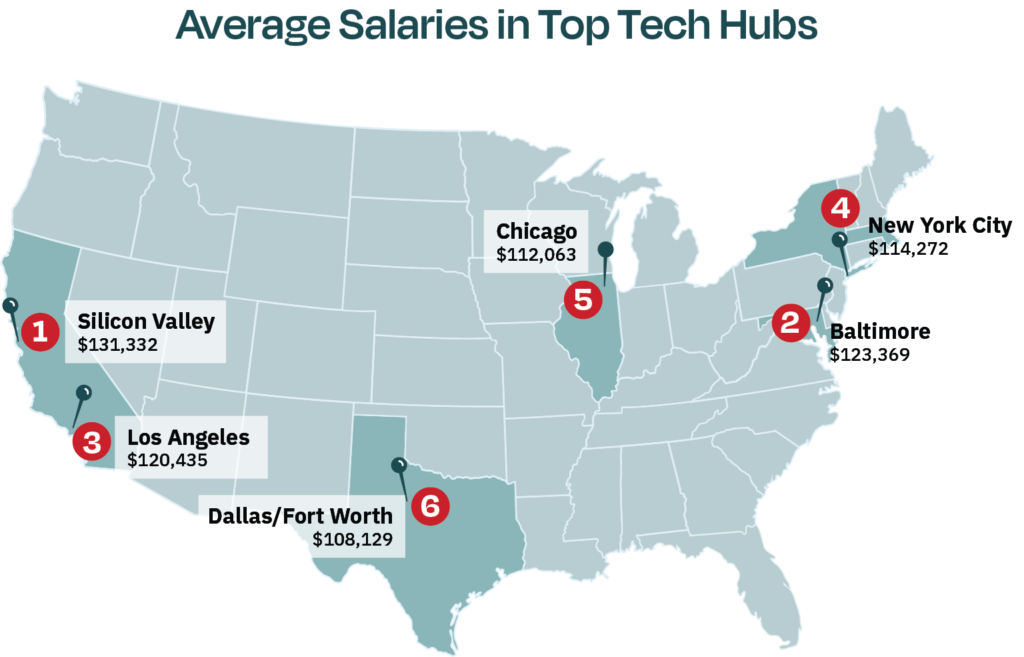
Silicon Valley maintained its tech salary dominance over other cities in 2024, even though it saw a 7.3% decline from last year. The Baltimore/Washington D.C. area saw the most growth at 5.8%, with Dallas/Fort Worth and Los Angeles gaining as well.

*Sample size less than 100 respondents, therefore not statistically valid. Presented for continuity purposes only.

Average Tech Salaries by Region

Average Tech Salary by City

Tech Companies Continue to Deliver Higher Salaries

Even in a year marked by high-profile layoffs, tech companies haven’t lost their edge when it comes to compensation for tech professionals: those working at tech companies earn 5.7% more than their peers in other industries, and this gap is growing—tech companies increased salaries by 2.2% in 2024 even as other sectors saw a decline.

A look at our survey demographics is also revealing: tech companies attract the highest percentage of professionals aged 25-34, while those over 45 are more likely to work in non-tech industries. This shift may reflect both voluntary and involuntary factors. Tech professionals older than 45 were the most affected by 2024’s industry layoffs, which occurred more frequently in tech than other sectors. Some of these more experienced workers may also be choosing roles outside tech to prioritize work-life balance over compensation.

For tech industry recruiters and HR professionals, these trends present a clear place for reflection. To maintain a diverse, experienced workforce, companies must address the factors driving seasoned professionals away from the industry and make improvements, whether through enhanced job security, improved work-life balance, or more competitive benefits packages.

*For the purposes of this survey, we defined a technology company as one that includes digital electronics, software, internet-related services and e-commerce services.

Average Salaries for Tech Professionals Inside the Tech Industry*

$114,861

+2.2% year over year

Average Salaries for Tech Professionals Outside the Tech Industry*

$108,674

-0.5% year over year

Shifting Salary Patterns within Career Stages and Roles

Mid-career professionals were the clear winners in this year’s salary adjustments based on experience. Those with 3-5 years of experience saw a nearly six percent salary increase, marking a significant reversal from last year’s eight percent decline. This rebound suggests employers are investing more heavily in retaining professionals who have proven their capabilities but haven’t yet reached peak compensation levels.

Tech professionals with more than 15 years of experience continued their upward trajectory, though barely. This group experienced a modest 0.5% increase, maintaining their position as the highest-compensated cohort with average salaries of $133,047. The slower growth rate may reflect that many of these professionals have already reached senior compensation bands within their organizations.

Last year proved most challenging for those early in their careers. Entry-level tech professionals (2 years or less) experienced a second consecutive year of salary declines, with a 1.4% decrease. This continued downward pressure on entry-level compensation likely reflects both market conditions and the increasing supply of early-career talent.


AI Skills Command Nearly 18% Premium Over Other Tech Roles

Year after year, we expect to see managers and executives at the top of the salary charts. This year was no different, with IT management roles again the highest salaries represented in our survey, followed by software developers. These salary patterns reflect a persistent truth in tech: organizations are willing to pay a premium for professionals who can both understand the technology and guide others in implementing it.

The arrival of artificial intelligence as a critical business capability is creating another significant compensation disparity within tech roles. Professionals responsible for designing, developing, or implementing AI solutions command salaries 17.7% higher than their peers not involved in AI work—a premium that extends beyond base compensation differences. We also noted, however, that tech professionals working on AI initiatives are also more likely to hold senior positions, particularly in management and executive roles (CEO, CIO, CTO, VP, Director). This concentration of AI responsibilities at higher organizational levels partially explains the substantial salary advantage.

The impact of AI responsibilities extends beyond compensation alone. Tech professionals involved in AI initiatives report notably higher job satisfaction compared to their counterparts, even when controlling for salary levels. This satisfaction gap persists even as non-AI focused roles see salary increases, suggesting that involvement in AI work may offer intangible benefits beyond monetary compensation.

Tech professionals could earn a $10k pay bump if they gained expertise in the following 9 skills:

  • Artificial Intelligence
  • Cloud Computing
  • C#
  • Docker
  • Cyber Security
  • DevOps
  • BASH
  • Software as a Service (SaaS)
  • VMWare ESXi

Support Roles Experience Salary Slip

Of the nine roles we analyzed for year-over-year trends, only two saw notable salary declines: Systems Administrators and Help Desk Technicians. The decline of help desk technician salaries is especially interesting, as the role experienced a nearly 5 percent increase in last year’s salary survey. Perhaps we are seeing the impact of AI driving change in the workplace, as more companies use AI tools to automate many aspects of the help desk, or a younger and tech-savvy workforce is slackening demand for help-desk assistance.

Tech Salaries by Occupation

Change in Tech Salaries by Occupation

Change Since 2023


Fastest Growing Tech Salaries by Skill

Growth Since 2023

Recruitment Opportunities for 2025

Overview

While 2024’s modest 1.2% average salary increase might suggest that employers again have the upper hand when it comes to tech hiring, our data reveals the workforce is readjusting its expectations and making moves.

With 47% of employed tech professionals actively job hunting (up from 29% last year) and record-high compensation dissatisfaction, it’s clear that last year’s job-market turmoil is translating into a notably strong urge to jump jobs. For organizations everywhere, this impulse can severely impact productivity, innovation, and the ability to preserve institutional knowledge.

Salary benchmarks alone aren’t capturing these trends. Fortunately, with change comes opportunity. The recruitment community is likely to see a lot of action in 2025 as tech professionals shuffle to new roles.

In this chapter, we discuss the nuances underneath the dissatisfaction rate among tech professionals and offer HR teams advice for building strong tech teams in spite of so much discontent.

Prefer to learn in audio?

Click the video to listen to the narrated version of this chapter.

Key Findings

Tech compensation satisfaction hit an all-time low in 2024.

Read More

Nearly half of tech professionals in our survey are actively seeking a new role, up significantly in 2024.

Read More

More tech professionals were laid off in 2024, jumping 7 percentage points from 2023.

Read More

The percentage of tech professionals indicating their salary has increased from one year ago is down significantly from 2023.

Read More

Overall Satisfaction Reaches Historic Low

2024 saw tech compensation satisfaction at an all-time low, with only 41 percent of tech professionals reporting they were either “very” or “somewhat” satisfied with their compensation. This represents a significant decline from previous years, as an equal percentage, 42 percent, now express active dissatisfaction with their compensation packages—up notably from 35 percent in 2023.

This growing dissatisfaction appears to be driven by multiple factors:

  • A record 59% of tech professionals feel underpaid compared to their peers, up from 54% in 2023. Dating back to 2021, the amount of tech professionals feeling underpaid has steadily grown each year.
  • Less than half (45%) of tech professionals received a salary increase in 2024, down significantly from 55% in 2023.
  • The rate of employers offering several key benefits (401K, Health insurance, PTO, Remote work, etc.) appears to be declining. We discuss this at length in our next chapter.

People’s perception of their salary is also impacted by their sense of security and stability, two things that are heavily influenced by external factors. For starters, tech professionals face very real economic concerns, such as a rising cost of living, which impacts the buying power of a salary that, in many cases, did not increase this year. In fact, according to our recent Tech Sentiment Report, only 31% of tech professionals felt optimistic about the economy in 2024.

Additionally, there is a strong narrative within tech communities that the job market is difficult to navigate and more layoffs are on the horizon. Only four in ten respondents to our tech sentiment survey felt confident about their ability to find a satisfactory new role in the current hiring market.

Interested in Learning More about Tech Talent Satisfaction?

Our recent Tech Sentiment Report offers the data-driven insights you need to understand how tech professionals think and feel about the industry, their jobs and what they want from employers like you.

Job Security Fears Drive Career Moves

The tech industry’s response to another year of economic pressure included more layoffs. Nearly one in five tech professionals in our survey experienced a layoff—a seven percentage point increase from 2023. Another 25% express concerns about potential layoffs at their companies, particularly among younger professionals aged 18-24—34% of whom report layoff anxiety.

Also interesting: tech professionals over 45 were more likely to be laid off than their younger counterparts. Considering that many of these older tech professionals sit in management roles, this aligns with broader industry observations about the reduction of middle management roles, a phenomenon Business Insider discussed in their recent article, “The Great Flattening is Here to Stay”. According to them, these middle management positions are being permanently removed from organizational structures, with no indication these roles will return. This structural shift results in a major change for experienced tech professionals on the management track, while presenting HR teams with the challenge of supporting much of the mentorship and culture building work this population led.

This combination of increased layoffs and layoff anxiety appears to be creating a self-perpetuating cycle of concern among tech professionals, where fears about job security increase job searching, which in turn may lead to shorter tenure in a role and less institutional loyalty. In fact, job searching has shifted dramatically in response: 47% of employed tech professionals are actively seeking new positions, up sharply from 29% in 2023. For HR leaders and recruiters, messaging around job security and stability has never been more important.

How, if at all, have you been impacted by tech layoffs that have been in the news recently?

Approximately how long did it take to find your current job after being laid off?

Describe Your Job Seeking Status

Traditional Pay Increases Fade Away

The share of tech professionals that claim their yearly income either didn’t change or decreased from the previous year has grown significantly year-over-year. Additionally, merit-based raises, traditionally the primary driver of salary increases, have become less common in 2024. Only 36% report receiving a raise, down five percentage points from last year. Significantly fewer professionals received bonuses, as well, at 31% compared to 39% in 2023.

The rise in consulting roles (15% of respondents, up from 9% in 2023) has naturally led to fewer professionals receiving traditional employment benefits such as raises and bonuses. Even so, more tech professionals experienced a compensation decrease year over year, regardless of employment type.

Income Change from One Year Ago

What is the main reason for your salary increase?

What is the main reason for your salary decrease?

What Makes A Happy Tech Worker?

What else drives compensation satisfaction (or dissatisfaction) in tech? Our analysis uncovers interesting patterns in satisfaction levels that cut across experience, specialty, and demographic lines.

This satisfaction divide highlights the growing importance of role specialization, particularly in rising technologies like AI, where professionals report significantly higher compensation.

More Satisfied:

  • Consultants
  • Tech professionals with 15+ years of experience
  • Professionals age 55+ (despite being more likely to report salary decreases)
  • Those with security clearances
  • Software developers/engineers
  • Professionals in Atlanta

Less Satisfied:

  • Women in tech
  • Professionals at companies in decline
  • Education and healthcare industry workers
  • Those not involved in AI development
  • Early-career professionals

Recruitment Opportunities for 2025

Overview

A close eye on benefits trends is always important for HR leaders and recruiters intent on building strong tech teams. This focus has become more critical than ever in a year where tech satisfaction is at an all-time low and nearly half of tech professionals are seeking to leave their current organizations. While close attention to these trends can help improve retention rates, there is also a strong opportunity for recruiting teams to find and deliver the work experiences that top tech talent wants – and isn’t getting.

This chapter explores not only what benefits tech professionals value most, but also how leading organizations are building their benefits strategies to attract and retain top talent. We’ll examine which benefits drive the highest satisfaction rates, where the most significant gaps exist between employee expectations and current offerings, and how different demographic groups respond to various benefits packages. For talent acquisition teams, this information provides crucial insights for crafting compelling offers. For HR leaders, it offers a roadmap for designing benefits packages that can help reduce the record-high 47% of tech professionals currently seeking new positions.

Prefer to learn in audio?

Click the video to listen to the narrated version of this chapter.

Key Findings

Even though salaries have increased on average in 2024, companies seem to be scaling back valuable benefits, as fewer tech professionals report receiving them year over year.

Read More

The gap between desired and offered benefits continues to grow.

Read More

Just as many tech professionals received a bonus in 2024, though bonus amounts have decreased by $817 on average.

Read More

Remote work has become increasingly critical for job satisfaction, yet companies are rolling back these options.

Read More

The Widening Gap In Employee Benefits

Among full-time employees, traditional benefits, such as health insurance, PTO offerings, dental coverage, and retirement benefits, saw slight declines across the board in 2024, reversing a long-standing trend of stable or expanding offerings. More significant declines were seen across less common benefits. For example, tech professionals who received training and education from their organization in 2024 dropped 6 percentage points. Financial advising, paid volunteer opportunities, flexible scheduling, mental health programs, and college tuition reimbursement all lost ground as well, at a four percentage point year over year decline.

Perhaps most telling is the current state of professional development opportunities in an environment where upskilling is key to career growth for tech professionals. While 71% of tech professionals consider training and education opportunities an important benefit, only 41% report having access to these opportunities through their employer. This 30-point gap represents one of the largest disconnects between desired and offered benefits in our study, highlighting a significant missed opportunity for employers to build loyalty and enhance workforce capabilities.

The Benefits Employees Have vs. Those They Find Important

Remote Work Remains A Battleground

26% of tech professionals rank remote work options in their top two benefits

Remote work is a critical factor in job satisfaction in 2024, yet our data shows companies are moving in the opposite direction when it comes to employee preferences. Remote scheduling options decreased by 3 percentage points in 2024, while flexible scheduling arrangements fell by 4 points.

This pullback comes despite clear evidence that flexible work arrangements remain highly valued, particularly among specific demographic groups. Our data shows that tech professionals with children in their household are more likely to have and utilize remote and flexible scheduling options. The reduction in these offerings may disproportionately impact working parents and could influence retention rates among this demographic.

The State of Performance Pay for Tech Workers

Bonuses seemed to take a hit as well in 2024, though the full story is more nuanced than the numbers first suggest. At first glance, the drop in professionals receiving bonuses, from 39% in 2023 to 31% in 2024, looks alarming. However, this year’s study included a larger proportion of consultants (15% versus 9% in 2023) and fewer full-time employees. When we focus solely on full-time tech professionals with more than one year in their current role, the bonus rate holds steady at 39%, matching last year’s levels.

However, even accounting for this demographic shift, bonus amounts tell a concerning story. Among those who received bonuses, the average amount decreased by $817 compared to the previous year.

Merit raises also showed a troubling trend. While these increases historically served as a reliable path to compensation growth, only 36% of tech professionals received a merit raise in 2024—down from 41% in 2023. This signals a potential shift in how companies approach performance-based compensation, even when controlling for employment type.

Did you receive a bonus this year?*

2024 Survey Results

Yes: 31%

2023 Survey Results

Yes: 39%

*Rebased to only include tech professionals with more than one year in their current role.

Average Bonus for Tech Professionals

2024 Survey Results

$14,194

2023 Survey Results

$15,011

What Benefit Trends Mean for 2025

With nearly half of tech professionals looking for new jobs, companies cannot afford to ignore the connection between benefits cuts and employee satisfaction. As we move into 2025, employers must carefully weigh the short-term savings of reduced benefits against the long-term costs of increased turnover and decreased satisfaction. Companies that enhance their benefits packages to meet tech professionals’ wishes won’t just build a happier workforce, they will attract the best in tech – a move that will pay dividends on the agility and innovation a company is capable of.

Recruitment Opportunities for 2025

Salaries by Skill

Resource Library

Explore other content created with our 2025 Salary Survey data, featuring videos, podcasts, guides, webinars, and more.

Video

On-demand Webinar

Watch industry leaders take a data-driven exploration of tech hiring trends, featuring exclusive insights from Dice's 2025 Tech Salary Report. Learn how AI, certifications, and workplace evolution are reshaping compensation and retention strategies in today's dynamic market.

Watch On-Demand
Video

20 Years of Tech Transformation

Whether you're a hiring manager looking to build stronger teams or a tech professional planning your career moves, this deep dive into two decades of industry evolution offers invaluable insights for 2025 and beyond. Based on exclusive data from Dice's 2025 Tech Salary Report, this video looks back at 20 years in tech

Watch Now
Podcast

Tech Connects Podcast

In this podcast episode Dice CEO Art Zeile, and our host Nick Kolokowski discuss the impact of inflation on tech salaries over time, what's next for tech professionals who want to grow their compensation and so much more. Listen in!

Listen Now
Blog

Why Tech Talent Leaves in 2025

Tech pros are ready to quit despite rising salaries - 47% are job hunting, up from 29% last year. From vanishing remote work to training gaps, discover why benefits matter more than pay in 2025's talent war.

Read Now
Video

Watch On-Demand

Join the conversation with two industry veterans as they unpack 20 years of seismic shifts in tech - from soaring salaries to AI disruption. Explore how the industry transformed from its early days to today's complex landscape, and what these changes mean for tech's future.

Watch Now
Blog

The Mid-Career Sweet Spot and Lessons from 2024's Biggest Winners

Mid-career tech pros emerged as 2024's biggest salary winners, with 6% gains while entry and senior levels stagnated. Discover why the 3-5 year experience sweet spot is commanding premium pay, and how to leverage it.

Read Now

About Dice

Dice’s hiring solutions help thousands of companies find and filter through millions of quality technology professional profiles, so you can quickly fill your open roles with the best tech talent. Equipped with AI matching tools, employer branding solutions and hiring insights tailored to individual recruiting needs, Dice makes it easy for recruiters and HR managers to post their jobs, source ideal talent and elevate their brands all in one place.

With a fresh perspective on connecting technology professionals to the companies that need them, Dice is the trusted way to hire and get hired in tech.

To learn more about what Dice can do to elevate your tech hiring, visit Dice.com/hiring today.