
How Tech Recruiters Can Build Real Technical Fluency (Without Becoming Developers)

Sourcing Candidates
  • March 19th, 2026
  • 9 min read

Summary

Already have an account? Log in.

If you’ve spent any time recruiting for technology roles, you’ve probably had the same unsettling experience I had early in my career: a candidate lists Kubernetes, Kafka, and a handful of microservices on their resume, and you nod along confidently during the call, while quietly having no idea whether they’re genuinely skilled or just good at stringing buzzwords together.

The truth is, most tech recruiters learn to memorize definitions. REST API. Docker. React. Microservices. They Google terms before calls, skim Wikipedia articles, and build a surface-level vocabulary before interviews with candidates.

That approach has a ceiling. And I hit it fast.

What actually changed my ability to evaluate tech talent wasn’t memorizing more terms. It was building a fundamentally different kind of understanding: systems thinking. Here’s how I got there, and how you can too.
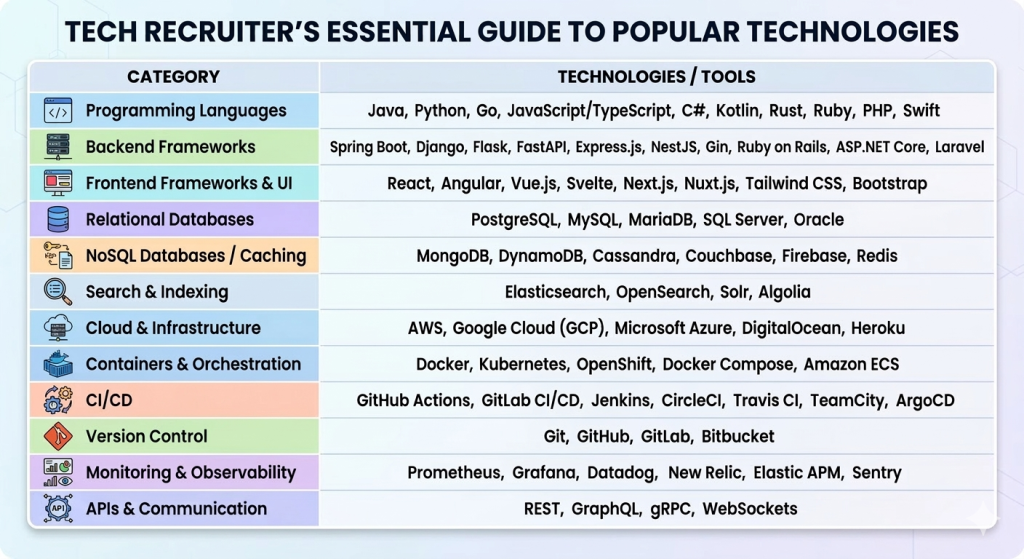

1. Stop Memorizing Buzzwords. Start Mapping Systems.

The problem with the definition-based approach is that technology doesn’t exist in isolation. Every tool, framework, and language sits somewhere in a larger system and understanding where matters far more than understanding what something is called.

When I started drawing simple architecture diagrams for every role I worked on, something clicked. A backend developer working in Go isn’t just “a Go developer.” They’re writing application logic in a language (Go), using a framework (Gin, perhaps), connecting to a database (PostgreSQL, MongoDB), deploying to infrastructure (AWS, Kubernetes), and pushing code through a pipeline (GitHub Actions, Jenkins). Each piece has a job. Each piece connects to the others.

Once you see it that way, when a candidate says they’re “a Senior Go engineer working on distributed systems deployed via Kubernetes,” you don’t just hear a string of nouns—you understand the architecture they’re operating in.

A useful exercise: for every role you work on, ask one of the engineers, “Where does this technology sit in the stack?” Most engineers genuinely enjoy explaining their systems to someone who’s curious. Use that. If you can visualize the architecture, you understand the role.

Flowchart showing Technical Fluency paths for tech recruiters.
The Technical Fluency Decision Tree for Recruiters, created by Andrew Stetsenko

2. Build Something Small 

This one felt intimidating to me at first, so let me be clear about what it does not mean: it doesn’t mean writing production code, mastering algorithms, or competing with engineers. It means building one small, functional tool that solves a real problem in your own workflow.

I built a basic resume analyzer that extracted and categorized technical skills from job descriptions. It wasn’t sophisticated. It wasn’t pretty. But building it exposed me to concepts I had only ever read about: how a frontend sends requests to a backend API, how that backend talks to a database, how you deploy something and make it accessible online.

After going through that process once, terms like “API endpoint,” “environment variables,” and “authentication” stopped being abstract. They became practical. When a candidate said they “built REST APIs and deployed services to AWS,” I had a mental model for what that actually entailed—writing backend logic, connecting to a database, handling requests and responses, configuring infrastructure, managing permissions.

You don’t need microservices or complex CI/CD pipelines to get there. A simple stack is more than enough: a basic frontend (React, or even plain HTML), a lightweight backend (Node.js or Python Flask), a simple database (PostgreSQL or Firebase), and a straightforward hosting platform like Vercel or Render. The technology is almost beside the point. The experience is what matters.

3. Use GlossaryTech to Learn Tech Terms in Real Time

Even with better systems knowledge, you’ll constantly encounter unfamiliar terms while sourcing. Stopping to Google every one of them kills your momentum and breaks your concentration.

Tools like GlossaryTech, Backed by Dice, a Chrome extension built specifically for tech recruiters, highlight technical terms directly on Dice profiles, GitHub repositories, and job descriptions, surfacing short contextual definitions when you hover over them. The real value isn’t the individual definition; it’s the repetition. When you see the same term appear across multiple resumes and job descriptions, you start building pattern recognition. You begin to notice which tools tend to appear together, how roles differ by technical focus, and what stacks suggest what kinds of work.

Here’s how Glossary Tech works:

4. Understand Seniority Through Scope, Not Years

This is one of the most costly mistakes I see tech recruiters make, and I made it myself for years: equating experience with seniority. The number of years someone has been working rarely tells you much. The scope of what they’ve owned does.

A useful mental model breaks it down this way:

  • Junior engineers implement tickets and need direction, they have limited exposure to architectural decisions. 
  • Mid-level engineers own features, make technical decisions within defined boundaries, and understand how system components fit together. 
  • Senior engineers design systems, make meaningful trade-offs, mentor others, and think seriously about scalability, reliability, and cost.

When I started asking candidates about system ownership, architectural decisions, incidents they’d handled, and performance bottlenecks they’d solved, instead of asking whether they “have experience with” a given tool, the quality of my screening calls improved dramatically. You stop getting rehearsed keyword responses and start getting real answers. Or the absence of them, which is equally useful.

5. Shadow Technical Interviews

Early in my agency recruiting days, I used to visit client offices and sit in on technical interviews. At the time, hiring managers were asking candidates to write JavaScript code and functions on paper, walk through real-world object-oriented design scenarios, choose design patterns for specific problems. It was a different era of interviewing, but the experience was irreplaceable.

Sitting in those rooms taught me things I couldn’t have learned from LinkedIn or a glossary. I watched how engineers evaluated depth. I heard what kinds of questions revealed actual understanding versus surface familiarity. I noticed what triggered concern: candidates who repeated buzzwords without explaining the reasoning behind their choices, or who couldn’t describe what they’d actually owned versus what their team had built.

If you can get permission to observe even two or three technical screenings or system design interviews, do it. You’ll start recognizing patterns that would take years to learn otherwise.

6. Ask About Trade-Offs, Not Just Tools

The shift from good recruiter to trusted technical partner often comes down to how you frame your questions.

Asking “Do you have experience with microservices?” gets you a yes-or-no answer. It tells you almost nothing. Asking “What problems did microservices solve for you compared to your previous architecture and what challenges did they create?” gets you a real answer. It tells you whether the candidate actually made the decision, lived with the consequences, and understands the trade-offs involved.

Technology choices are fundamentally about trade-offs: microservices versus monoliths, SQL versus NoSQL, Kubernetes versus simpler container management, serverless versus container-based infrastructure. 

When you understand why engineers make these choices and what they give up in the process, your questions become sharper, your screening becomes more accurate, and your credibility with hiring managers grows.

7. Debrief After Every Hire

One of the most underused practices in technical recruiting is the post-hire debrief. After closing a role, I started scheduling 20-minute conversations with hiring managers to ask: What skills were truly critical? What separated the best candidate from the rest? What did weaker candidates consistently misunderstand? What would you screen for differently next time?

Over time, those conversations built something valuable: pattern recognition. I started to understand the real difference between mid-level and senior in specific domains. I could tell the difference between genuine Kubernetes experience and resume keyword stuffing. I could identify candidates who had deep frontend ownership versus those who had touched React on a few features without understanding the architecture.

Document what you learn. It compounds quickly.

8. Create a GitHub Account and Use It

If you recruit engineers, you should understand the platform many of them use every day. GitHub is where millions of engineers collaborate on software.

Creating your own GitHub account and publishing something simple: a recruiting resource, a salary dataset, or structured notes, teaches you more than any description of version control ever could.

Here are some examples you can build to learn how GitHub works and maybe even pick up some stars and contributors along the way:

  • A GitHub repo by Sjamilla with recruiting tools (github.com/Sjamilla/awesome-recruitment)
  • A GitHub repo by DopplerHQ with awesome interview questions (github.com/DopplerHQ/awesome-interview-questions)
  • A GitHub repo by mtdvio with things every developer should know (github.com/mtdvio/every-programmer-should-know)

Learning the basics matters here: what a repository is, how commits track changes over time, how branches work, what a pull request represents, how Markdown is used in README files. Even writing a clean README forces you to think about how engineers document their work and structure information for others.

When a candidate says they ‘contributed to open source,’ you can actually look. A recruiter who understands Git can see whether they made a minor typo fix three years ago or have been consistently submitting meaningful pull requests. That’s a real signal.

As you grow more comfortable, consider contributing small documentation improvements to popular repositories and open-source projects. 

9. Attend (and Eventually Speak at) Developer Conferences

Developer conferences are one of the fastest ways to absorb how engineers actually think and communicate. You hear how they discuss architecture and trade-offs, what tools they’re excited about, what trends they’re skeptical of, and how technical leaders think about scaling and infrastructure. High-level talks from CTOs and engineering directors give you industry context that goes far beyond individual tool definitions.

Very few tech recruiters attend deeply technical events. That makes it easier to stand out, and easier to build relationships with engineers in their own environment.

A more advanced move, one I’d recommend once you’ve built up some technical fluency, is to speak at a developer conference yourself. Not on technical internals, but on topics where you genuinely add value: career development, hiring trends, evaluating offers, how engineers can position themselves for senior roles. Preparing a talk forces you to raise your standards. You have to understand your audience, anticipate technical questions, and communicate clearly in their language. It moves you from being adjacent to the engineering community to participating in it.

10. Ask Questions Relentlessly

The most underrated approach to building technical fluency is also the simplest: ask questions, constantly, of the people around you.

If you work in-house, you likely sit near developers, product managers, or engineering leads. Use that proximity. Ask them to explain how the product works, how the architecture is structured, what technologies are load-bearing versus secondary, where the real complexity lives. Most engineers are genuinely willing to explain their work when they see honest curiosity and respect.

If you work in an agency, the candidates you’ve already placed are an underused resource. After someone onboards, ask them what they’re actually working on. What does their system look like? What challenges are they running into? What tools are central to their day-to-day work? These conversations are often more candid and educational than pre-placement interviews.

There’s nothing wrong with not knowing something. What damages your credibility is pretending to know and misusing the terminology. Engineers respond to informed curiosity. 

Over time, consistent questioning builds real depth, not just definitions, but reasoning. Why this framework instead of another? Why this database? Why this architecture? Those answers are where technical fluency actually lives.

What Technical Fluency for Recruiters Actually Looks Like

Let’s be clear about what all of this does and doesn’t require.

It doesn’t mean writing production code, solving algorithmic problems, or competing with the engineers you’re hiring. It means understanding architecture at a high level, knowing how technologies relate to each other, detecting shallow answers, asking intelligent follow-up questions, and challenging vague or inflated hiring requirements.

Engineers respect recruiters who don’t misuse terminology, who understand the trade-offs behind technology decisions, who come to conversations prepared, and who treat software development as a craft worth understanding. They ignore recruiters who blindly match keywords and ask questions whose purpose they clearly don’t understand.

The good news is that real technical fluency for recruiters is genuinely achievable. It doesn’t require a computer science degree or years of coding experience. It requires curiosity, consistency, and a willingness to learn from the engineers you work with every day.

The next time a candidate mentions Kubernetes or Kafka, you won’t need to pretend you understand every detail. Instead, you’ll ask a better question: 

“What problem were you solving when you introduced Kafka and what did that decision cost you?”

Answers to questions like that reveal far more than any list of technologies ever will. They show how someone thinks, what they’ve owned, and how they make trade-offs. And once you start listening for those things, you’re no longer just matching keywords on a resume. You’re evaluating engineering work the way engineers do.


Andrew Stetsenko is an HR-tech entrepreneur with 15+ years of experience working in the tech industry. He advises tech recruiting and employer branding teams on global hiring strategies.

You may also like

View all posts
How Dice Tools Help You Build an Automation Team

How Dice Tools Help You Build an Automation Team

  • March 18th, 2026
  • 4 min read
Read now
Podcast Overview: How AI Agents Are Reshaping the Recruiting Process

Podcast Overview: How AI Agents Are Reshaping the Recruiting Process

  • March 4th, 2026
  • 2 min read
Read now
How the Dice MCP Server Sharpens Your Candidate Pipeline 

How the Dice MCP Server Sharpens Your Candidate Pipeline 

  • January 29th, 2026
  • 2 min read
Read now
View All Posts